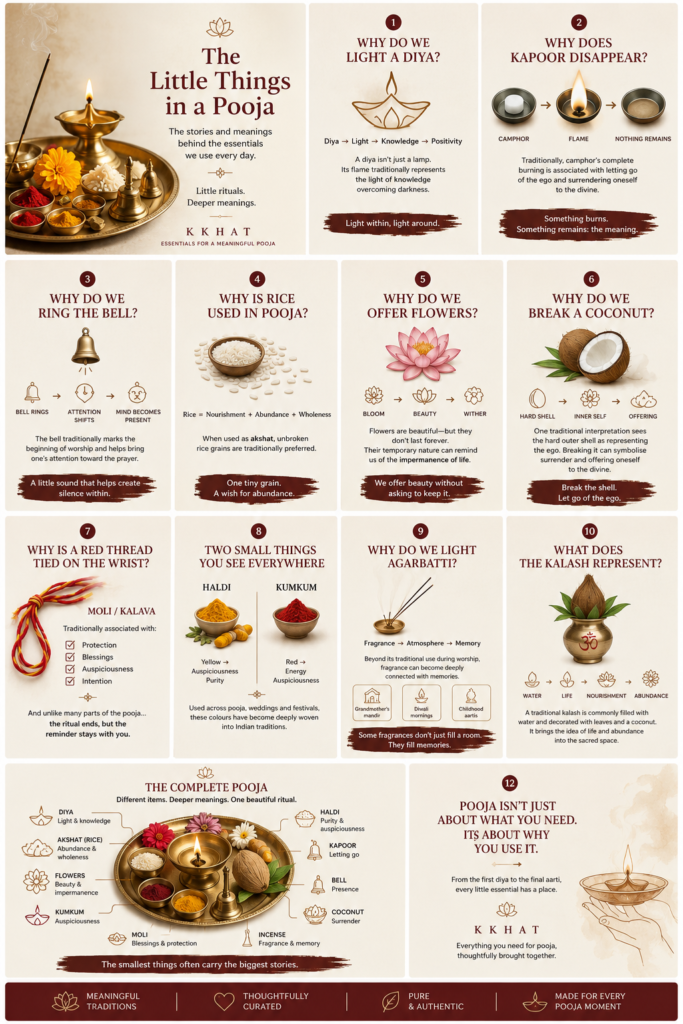

Have you ever noticed how a pooja is made up of so many little things?
A diya is lit. A few grains of rice are placed. Flowers are offered. Kapoor is lit during aarti. A red thread is tied around the wrist. A coconut rests on a kalash.
We grow up watching these rituals, often knowing what to do—but not always knowing why we do it.
And perhaps that is the most beautiful thing about Indian traditions. Behind many of these ordinary-looking objects is a little story, a symbol, or an idea that has travelled through generations.
So, the next time you sit down for a pooja, look a little closer.
Here is the story behind some of the smallest things that make a pooja complete.
It Begins With a Diya
Before the prayers begin, there is often one small flame.
A diya.
It may look like a simple lamp, but the idea behind lighting it is much bigger than the flame itself.
In Indian traditions, light is associated with knowledge, clarity and positivity, while darkness represents ignorance. Lighting a diya is therefore a symbolic way of welcoming light into the space—and into the mind.
There is also something beautifully human about it.
Think about the moment just before a pooja begins. The room may be quiet. Someone lights the first diya, and suddenly the atmosphere changes.
The flame becomes a gentle reminder:
Before we ask for anything, let us bring some light first.
And that is why the diya has remained at the heart of Indian homes for generations.
Why Do We Put a Cotton Wick in It?
The diya needs a wick to carry the flame.
Traditionally, cotton wicks are used because cotton is a natural material that absorbs oil or ghee and allows the flame to burn steadily.
But there is also a deeper symbolism often associated with the wick.
The wick gives itself to the flame completely.
In that sense, it is sometimes seen as a reminder of surrender—of letting go of the ego and allowing oneself to become part of something greater.
A tiny cotton thread.
A surprisingly big idea.
And Then Comes Kapoor
You probably know it as kapoor.
You may have seen someone place a small piece of camphor on an aarti flame and watch it disappear almost completely.
That disappearing act is actually the reason camphor carries such symbolic meaning.
Camphor burns without leaving much residue behind. Traditionally, this has been associated with the idea of the ego dissolving completely in devotion.
There is something poetic about that.
The camphor begins as something solid.
Then there is a flame.
And slowly, nothing remains.
It becomes a reminder that devotion is not only about asking for something—it can also be about letting go.
Why Do We Ring the Bell?
That familiar ghanti sound is one of the first sounds you hear in many temples and homes during pooja.
But did you know that the bell isn’t simply there to make the pooja feel more ceremonial?
Traditionally, ringing the bell is believed to mark the beginning of worship and help draw one’s attention towards the divine.
And there is a very relatable idea behind it.
Imagine your mind five minutes before pooja.
Messages.
Work.
Studies.
Things you forgot to do.
The bell rings.
For a moment, your attention shifts.
That is perhaps one of the most practical meanings of the ritual: be present.
The bell doesn’t just ring through the room.
It interrupts the noise in your head.
Why Rice?
Rice—or akshat when used ritually—is another item we often see without thinking much about it.
Rice has historically been considered a symbol of abundance because it is a staple food and an important crop across much of India.
During rituals, rice may be offered as a symbol of prosperity, nourishment and completeness.
There is another interesting detail.
The word akshat is associated with something that is whole or unbroken. This is why unbroken rice grains are traditionally preferred in many rituals.
Something as ordinary as a handful of rice suddenly becomes a wish for wholeness and abundance.
Why Do We Offer Flowers?
Flowers are temporary.
They bloom, look beautiful for a while, and eventually wither.
And perhaps that is exactly what makes them such a meaningful offering.
Offering flowers can represent beauty, purity and devotion.
But there is a quieter lesson hidden in it too.
We offer something beautiful without expecting to keep it forever.
It reminds us of the temporary nature of everything around us.
The flower doesn’t need to last forever to be beautiful.
Maybe that is the point.
The Story Behind Haldi
Turmeric, or haldi, has been part of Indian households for centuries.
Long before it became a familiar ingredient in kitchens and beauty rituals, turmeric was valued in traditional Indian practices for its distinctive colour and properties.
Its bright yellow colour also came to be associated with auspiciousness, prosperity and purity.
That is why haldi appears in so many ceremonies—not just pooja, but weddings, festivals and other important occasions.
There is something fascinating about how one ingredient can move so effortlessly between the kitchen, the home and the sacred space.
Why Kumkum and Roli?
The red colour of kumkum and roli is hard to miss.
Red has traditionally been associated with auspiciousness, energy and prosperity in Indian culture.
The tilak is not merely decoration.
Depending on the tradition, it can represent blessings, devotion or the marking of an auspicious moment.
And perhaps this is why even today, a simple red dot on the forehead can instantly make a moment feel ceremonial.
The Red Thread on Your Wrist
You might have had a moli or kalava tied around your wrist during a pooja without ever asking why.
Traditionally, the sacred thread is associated with protection, blessings and a commitment to certain values or intentions.
It is also a beautiful example of how Indian rituals carry something beyond the moment itself.
The pooja ends.
The flowers are removed.
The diya eventually goes out.
But the thread stays on your wrist.
Almost like a small reminder of the prayer you just made.
Why Is Coconut So Important?
Walk into almost any Indian celebration and chances are, you will find a coconut somewhere.
The coconut is often associated with purity, auspiciousness and offering.
One traditional interpretation connects its three markings or “eyes” with the three eyes of Shiva.
There is also a beautiful symbolic story around breaking a coconut.
The hard outer shell can represent the ego, while breaking it represents surrendering that ego before the divine.
So when a coconut is broken during an auspicious ceremony, it isn’t simply about breaking a fruit.
It can represent breaking through the outer self and offering what is within.
And Then There Is the Kalash
The kalash is one of the most recognisable objects in many Hindu rituals.
A vessel filled with water, often decorated with mango leaves and a coconut, it represents abundance, life and auspiciousness in many traditions.
And think about what water means in everyday life.
We cannot live without it.
So placing water at the centre of a ritual is almost like acknowledging one of the most fundamental gifts of life.
The kalash quietly brings the idea of life, nourishment and abundance into the pooja space.
Why Do We Use Incense?
Agarbatti and dhoop are often used to create fragrance during pooja.
But fragrance has always been closely connected with memory.
One particular smell can take you back years.
The smell of incense might remind someone of their grandmother’s mandir.
Of waking up on a festival morning.
Of a childhood Diwali.
Of standing beside their mother during aarti.
That is one reason these seemingly simple things become so powerful.
They don’t just fill a room with fragrance.
They fill memories with meaning.
The Pooja Thali: Bringing Everything Together
And finally, there is the pooja thali.
A single plate carrying many of these essentials together.
Diya.
Roli.
Rice.
Flowers.
Kumkum.
Camphor.
Each item has its own purpose, yet they come together as one.
And perhaps that is what a pooja is really about.
Not one object.
Not one ritual.
But many small acts coming together to create a moment of gratitude.
Tradition Doesn’t Always Need to Be Complicated
We often think traditions survive because they are grand.
But look closely.
Many of them live inside the smallest things.
A cotton wick.
A pinch of rice.
A flower.
A little camphor.
A red thread.
A flame.
These are things we might otherwise overlook.
Yet each one carries a story that has been passed from one generation to another.
And that is what makes preparing for a pooja so special.
You are not simply collecting things.
You are bringing together pieces of a tradition.
At Kkhat, we believe that preparing for pooja should feel just as thoughtful as the pooja itself.
Because when you know the meaning behind the little things, even the simplest ritual starts to feel a little more special.
Kkhat — bringing the little essentials of tradition together.